Prof. Rahul Dave
Prof. Rahul has been a mentor of mine for quite some time, guiding the development of our Univ.ai product. He has lectured at Harvard University and is currently an adjunct professor at Hult University. I had the opportunity to speak with him and gain valuable insights. His feedback and evaluation were truly transformative, making a significant impact.
Learnings
Pinnacle to good content is less on the edtech but more on the coordination among multiple elements . It Needs better UI/UX
The EdTech industry is in dowfall as of this moment especially in india
Market selection is priority uno for any business but its 10x for edTech . India vs China example .i.e per capita earnings .
Youtube and other content deliver platforms would increase in size and video would be prominent mode of content delivery
His Main pain is to find data he wants to find
The Demographic for creating video app should be Podcast creators and probably not professor . Not to scope it down to edTech.
If there was this solution he would but it .
The tool would be great but not an urgent and critical requirement especially for educators
Make output of high quality . i.e audio and video
Pitch : Get high production quality with minimal effort
Mr. Piyush bansal
Piyush Bansal is a seasoned marketing expert with over 7 years of experience in the industry. He runs a successful marketing agency that serves more than 100 clients, helping businesses elevate their brand presence and achieve measurable results. His deep understanding of digital marketing strategies and commitment to client success has established him as a trusted leader in the field.”
Learnings
However agency would want more features and control
Biggest Challenges
Data from Ad platforms seems not correct
optimal Budgeting
Video Ad Creation of reasonable quality
Users are skipping ads on websites subconciously
Issue is in creation on ads. Management part is already handled by lots of softwares eg https://hootsuite.com/
Industry Trends:
Industry is moving towards video ads Videos have higher engagement rates ~18% compared to 2% to static.
Nuances needs to be taken into consideration
Pricing and Value Proposition:
Agencies might be willing to invest $10,000 if they get a substantial number of seats, brand management capabilities, and clear thresholds for usage.
Agencies look for cost savings and increased output efficiency in their ad production.
Target Market and Use Cases:
Industries: Tech products and e-commerce are suitable targets for this tool, especially those needing high-volume ad production.
Localization: There’s an opportunity to cater to local languages and specific regional needs, such as Bhojpuri, which could add significant value.
Competitor Insights:
Facebook Ads: Understanding various types of ad campaigns on platforms like Facebook can help in broadening the AI’s capabilities.
Market Trends: High volume and low-cost ad production can be beneficial for SMEs and businesses with large e-commerce operations.
Operational Focus:
Tech Products: The focus should remain on tech products and e-commerce, avoiding industries with high-budget, high-quality requirements like luxury fashion.
High-Volume Output: Emphasize producing a large number of ads at a lower cost to appeal to SMEs.
Client Considerations:
Custom Contracts: Clients may require clear terms regarding the number of posts, stories, and word generations.
LOI (Letter of Intent): If the product can meet specific needs and demonstrate value, potential clients may be willing to sign an LOI to commit to purchase.
Pricing will depend on the number of seats, brands managed, and usage limits such as the number of generated videos or words.
Founder vs Agency
Founders would want us to handle everthing
Mr. Ashish Gupta
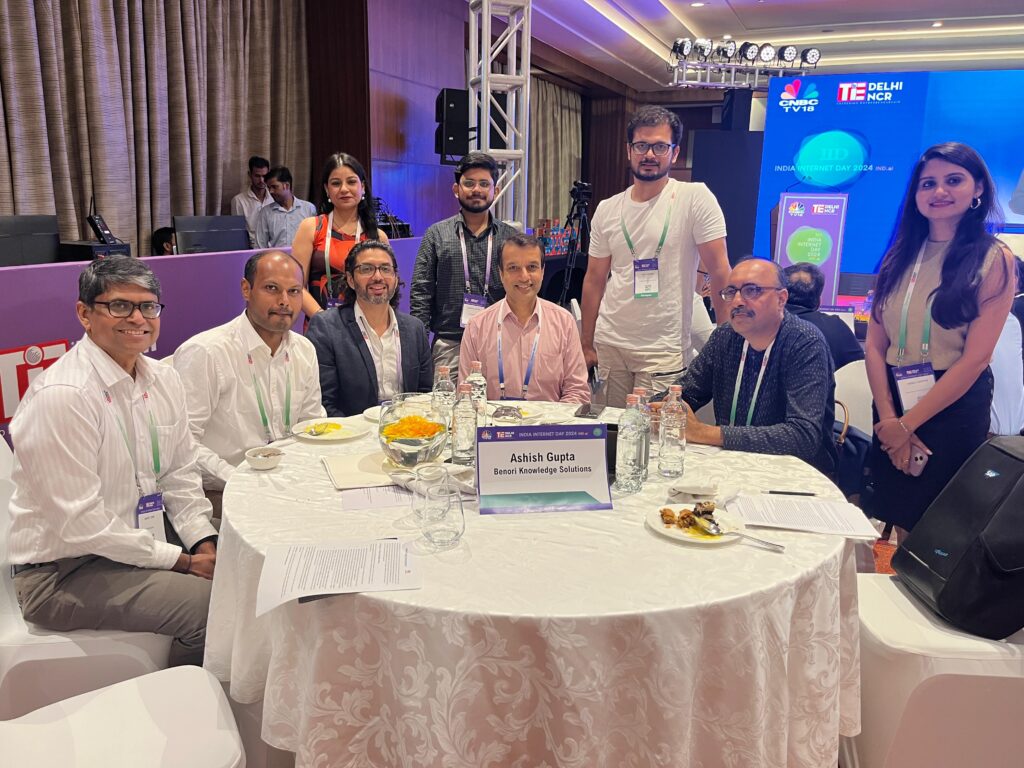
At India Internet Day 2024, I had the opportunity to meet Mr. Ashish Gupta, the founder of Evalueserve and Benori Solutions. During our discussion, I gained some valuable insights into building and scaling a business. Here are my key takeaways:
- Find users first: Build your product from the outside in, focusing on real user needs rather than internal assumptions.
- Talk to potential users: Constantly engage with as many users as possible to understand their pain points and refine your solution.
- Avoid VC funding early on: Stay bootstrapped as long as you can to maintain control over your vision.
- Funding stages: Bootstrap, seek funds from family, then angels, followed by social funds, HNIs, and eventually VCs.
- Define your business simply: When I explained Blinkadz as “We make sales easy,” he felt it could be clearer, pushing me to refine how I communicate the core value proposition.
This interaction challenged me to rethink how I present my business and approach growth strategically.
Mr Swatantra Kumar
Mr Swatantra Kumar
Swatantra Kumar is a seasoned entrepreneur and founder of multiple startups, including Able, an ed-tech platform that upskilled over 2.5 million users and was acquired by InstaWork. He’s a Y Combinator alum (W20) and has been recognized in Forbes 30 under 30 Asia. With extensive experience in building scalable tech products and guiding startups, he now serves as a mentor and tech advisor, helping founders navigate challenges in product development, growth, and fundraising.
Learnings
- Experiment and Validate Fast
- Don’t wait for a perfect product – launch quickly and iterate
- It’s better to have a basic but functioning product that some users hate but still use, than a sophisticated product no one uses
- Your product after a year may look very different from what you start with – this is normal
- Define and Test Thesis
- Create clear hypotheses about your product and market
- Example thesis structure: “If we solve X problem for Y audience, then Z outcome will happen”
- Validate each thesis through real user interactions
- Be ready to pivot if your thesis proves wrong
- User Acquisition Strategy
- Start with your network for initial B2B users
- Use personalized cold outreach on LinkedIn and email
- Consider offering free trials or risk-free periods to overcome trust barriers
- Focus on breaking past your current user count (2) at any cost
- Make it risk-free for early adopters to try your product
- Pricing Strategy
- Consider starting with lower prices to gain initial traction
- You can increase prices later once you prove value
- Don’t let pricing be a barrier to getting those crucial first users
- Focus and Momentum
- Maintain momentum in development and user acquisition
- Stay focused on solving user problems rather than thinking about exit
- Keep experimenting and learning from each iteration
- Combat self-doubt by maintaining continuous progress
- Problem Validation
- Talk extensively with potential users
- The problem you think you’re solving might not be the real problem
- Be prepared to discover that your initial assumptions might be wrong
- Keep refining your understanding of the user’s needs
- Product Development
- Stop adding features without user validation
- Launch even if the product is “crappy” but solves a real problem
- Focus on the core value proposition first
- Don’t get caught in an infinite loop of feature additions
- Mindset
- Treat early stages as experiments rather than a final product
- Be prepared for psychological challenges
- Maintain momentum to combat anxiety and self-doubt
- Focus on solving real problems rather than building perfect features
- Sales Approach
- For B2B marketing tools, address trust issues head-on
- Consider offering free trials to build case studies
- Use successful early adopters as references
- Focus on demonstrating concrete value rather than features
Mr. Rohit Arora
Mr. Rohit Arora
Rohit Arora is an accomplished digital marketing strategist and entrepreneur, known for his expertise in scaling startups and creating impactful growth strategies. As the founder of Mavenwit and Octane AI, he has extensive experience in developing data-driven marketing solutions and leveraging AI to enhance customer engagement. Rohit’s strategic insights have driven significant growth for multiple ventures, making him a valuable resource for identifying high-demand features and optimizing product development.
Learnings
- Target Market & Positioning:
- Focus on startups initially rather than agencies
- Agencies are harder to penetrate because:
- They have strict NDAs with big clients
- They’re protective of their data
- They have established processes
- Large companies (like WPP, Omnicom) are unlikely to adopt new tools easily
- Product Strategy:
- Start with a free model to gain initial traction
- Aim for 10 initial users to validate and tune the product
- Focus on delivering clear value before monetizing
- Consider expanding features gradually:
- Start with one industry
- Build specific value additions (PDFs, documents, reports)
- Then create targeted ads based on that content
- Growth & Funding Strategy:
- Need to show:
- User traction
- Revenue (even if not profitable initially)
- Community growth
- Clear metrics and growth trends
- Move quickly – suggested timeline of 6-9 months to show significant progress
- Focus on growth speed and metrics when seeking investment
- Unique Value Proposition Opportunity:
- There’s a potentially valuable feature suggestion: helping companies extract actionable data from their social media followers
- Could help collect:
- Email addresses
- Phone numbers
- Founder information
- Prospect data This could be a significant differentiator as “everyone wants leads”
- Market Timing & Evolution:
- New niches and categories take time to be understood
- Referenced how Maven wasn’t immediately understood when it launched
- Products need to keep evolving – mentioned how successful companies like:
- Freshworks
- Salesforce
- Zoho All expanded beyond their initial offerings
- Tool Preferences:
- Agencies prefer Sprout Social over Zoho Social for international clients
- Meta/Instagram is a major platform focus
- Key Success Factors:
- Speed of execution is crucial
- Need to show clear metrics and growth
- Important to think about “what’s next” even while building current product
- Having a clear data advantage or unique value proposition is important
Mr. John Martin
John is a seasoned Google Ads specialist with over 11 years of digital marketing experience. He’s Google Certified for Search, Shopping, Display & Video, and maintains a perfect 5-star rating from his clients. As a Google Partner, he specializes in delivering high-quality targeted traffic and ROI for diverse clients across eCommerce, SaaS, Lead Generation, Local Business, Finance, and Information Products sectors. His clients consistently praise his professionalism, expertise, and ability to optimize paid search campaigns effectively.
Key Insights:
Mr. John Martin
- Target Market & Current Solutions:
- Most established agencies don’t typically work with complete beginners/startups
- Google already offers AI-driven suggestions and setup wizards for beginners
- There’s potentially an underserved market of startups who can’t afford agencies
- Limitations & Challenges:
- Google Ads campaigns require significant context and market understanding
- Cookie-cutter solutions are difficult because “every single account is different”
- Basic automated setup wizards (like Google’s) tend to produce suboptimal performance
- Standard automated campaigns “lack context of understanding the market”
- Industry Trends:
- Google is increasingly moving toward automation
- Google’s in-house AI and machine learning capabilities are growing rapidly
- Marketers are gradually losing manual control to Google’s automated systems
- Google has vast resources and data advantages that could make them a formidable competitor
- Agency Pain Points:
- Two primary challenges:
- Client acquisition
- Client retention
- Common reasons for client churn:
- Growing businesses bringing marketing in-house after scaling
- Market downturns affecting small/medium businesses
- Small/medium businesses are more fragile to economic changes
- Enterprise clients tend to have longer retention
- Potential Feature Opportunities:
- Automation of repetitive manual tasks within accounts
- Rules-based automation systems (“if this happens, then do this”)
- Tools to help account managers save time on routine tasks
- Market Segments:
- Enterprise clients are more stable and have longer retention
- Small/medium businesses are more cost-sensitive
- Different market segments require different approaches and have different stability levels
- Business Model Considerations:
- The expert acknowledges that while AI might not match human expertise, it could serve businesses with limited budgets
- There’s a potential market for businesses that cannot afford agency services
Strategic Implications:
- Consider focusing on the underserved startup/beginner market segment
- Look for ways to differentiate from Google’s native automation
- Focus on building tools that complement rather than compete with Google’s automation
- Consider developing features that help agencies with retention and acquisition
- Build in flexibility to account for different business types and market conditions
Conclusion
Based on the interviews with Prof. Rahul Dave, Mr. Piyush Bansal, Mr. Ashish Gupta, Mr. Swatantra Kumar, Mr. Rohit Arora, and Mr. John Martin, here’s a concise conclusion:
The market shows clear demand for video ad creation tools, with video engagement rates (~18%) significantly outperforming static content (~2%). However, success will require careful positioning and execution. The experts consistently recommend:
- Target Market: Focus on startups and SMEs rather than agencies initially, as they represent an underserved market segment unable to afford traditional agency services.
- Product Strategy:
- Launch quickly with basic but functional features
- Start free to gain initial traction
- Aim for 10 initial users for validation
- Focus on high production quality with minimal effort
- Business Viability: While there’s opportunity in the market, key challenges include:
- Strong competition from Google’s native tools
- Need for significant differentiation
- Complex market understanding requirements
The consensus suggests Blinkadz could succeed if it:
- Maintains narrow focus on a specific niche
- Moves quickly (6-9 month timeline for showing progress)
- Differentiates clearly from existing solutions
- Prices competitively for SMEs while ensuring quality output
Vivek Valayapathy
Vivek Valayapathy
Vivek is a seasoned digital marketing professional specializing in PPC strategies for platforms like Google Ads and LinkedIn. With a strong background in growth strategies and paid search, he currently serves as the Global Digital Marketing Lead at Ignition. His experience includes key roles at companies such as Quadient, Refinitiv, and Thomson Reuters, where he led digital strategy and campaign optimization. Vivek’s expertise spans from strategic campaign management to achieving measurable ROI, making him a valuable asset in digital advertising and performance marketing.
Learnings
1. Enhanced Ad Creation and Management Capabilities
- Pain Points Identified: Current platforms are lacking in flexibility and efficiency, especially on LinkedIn. Problems include:
- Limited ad scheduling options, making it hard to optimize visibility based on audience activity.
- High costs associated with A/B testing, which makes experimenting with creative variations expensive.
- Long turnaround times from agencies for video creation, often taking 2-3 weeks to deliver.
- Inefficiencies in LinkedIn Managed Bidding, which depletes budgets quickly without achieving optimal results.
- Opportunity: BlinkAdz could differentiate by addressing these issues directly. Solutions like intuitive scheduling tools, cost-effective A/B testing features, quicker creative options, and optimized bidding tools would add significant value.
2. Key Challenges for PPC Professionals
- Creative Creation and Testing: A streamlined process for creating, testing, and iterating ad creatives will save time and reduce ad spend. BlinkAdz can add value by offering tools for quick creative testing with minimal costs.
- Campaign Optimization Across Platforms: BlinkAdz should focus on providing centralized tools for multi-platform campaign management, making it easy to monitor and optimize ads on both LinkedIn and Google.
- Competitor Benchmarking: PPC professionals need clear benchmarks to assess their performance. Benchmarking tools that provide insights into competitor spend, engagement metrics, and creative strategies can make BlinkAdz highly valuable.
- Comprehensive User Journey Reporting: Vivek emphasized the need for detailed reporting, from ad engagement through to conversion. A feature that maps out the end-to-end user journey with actionable insights will set BlinkAdz apart.
3. Understanding Platform-Specific Ad Objectives
- LinkedIn for Brand Awareness: Since LinkedIn is more effective for brand-building and reaching decision-makers, BlinkAdz should optimize for high-engagement, awareness-focused campaigns on LinkedIn.
- Google for Intent-Driven Searches: As Google is a platform for high-intent searches, tools that maximize ROI on Google Ads through optimized bidding and precise keyword targeting would be advantageous. BlinkAdz should tailor its features to support these distinct goals effectively.
4. Tiered Pricing Model
- To cater to diverse client budgets and needs, BlinkAdz should consider a tiered pricing structure based on:
- Ad Spend: Pricing should scale with ad budget, offering additional value for higher spenders through premium support and advanced tools.
- Creative Services: Options could include basic, standard, and premium packages, where higher tiers offer faster creative turnaround times and advanced creative testing features.
5. Focus on Salestech and Edtech Domains
- Vivek’s interest in these verticals suggests a targeted approach for BlinkAdz in industries where precise targeting and measurable ROI are crucial. This could include industry-specific templates, creative best practices, and benchmarks tailored for sales and education technology audiences.
6. Early Platform Testing
- Vivek’s willingness to test the platform highlights the importance of user feedback. Early testing phases should focus on:
- Ad creation tools that simplify and accelerate creative generation.
- Campaign management features that offer clear visibility into performance metrics and easy adjustments across multiple platforms.
Summary Recommendations for BlinkAdz
- Develop Unique Ad Creation Tools: Provide quick, affordable, and high-quality creative testing options, especially for video.
- Offer Multi-Platform Optimization Features: Enable seamless management and optimization across LinkedIn and Google.
- Implement Competitor Benchmarking Tools: Allow users to track industry trends and competitor performance.
- Enhance Reporting Capabilities: Include end-to-end journey tracking with conversion insights and actionable metrics.
- Adopt Tiered Pricing: Align pricing with ad spend and creative service needs to cater to a broad client base.
- Create Industry-Specific Solutions: Prioritize features and templates for the Salestech and Edtech domains.
Leave a Reply
You must be logged in to post a comment.